A therapist keeps detailed notes about her sessions — not just professional records, but the personal reflections she writes to process what she hears, the raw emotional observations that help her show up better for her clients. Her partner has never read these notes. Not because she is hiding something, but because they are hers. Private. Separate from the relationship.
Her partner has a running conversation with an old friend about career anxieties — things he has not yet told her, not because he is being dishonest, but because he is still working through his own thinking. He is not ready to share it. He has the right to not be ready.
Neither of these people is doing anything wrong. Both of them, on a shared device or with an inattentive moment, could have their private space violated. And both of them are right to want privacy that is not contingent on their partner’s permission.
This article is about digital privacy in relationships. It starts from a position that privacy is a fundamental human right, not evidence of wrongdoing. It covers the psychology of privacy in relationships, the legal landscape, the difference between healthy privacy and corrosive secrecy, and the practical tools people use to maintain appropriate digital space within intimate partnerships.
Privacy Is Not the Same as Secrecy
The conflation of privacy with secrecy — and secrecy with dishonesty — is one of the most damaging misconceptions about relationships and digital life.
Privacy is the maintenance of a personal sphere. It encompasses things that are genuinely yours alone: your inner thoughts, your developing ideas, your professional obligations, your medical history, your personal history before the relationship, your friendships, your creative work, your therapy.
Secrecy, in the harmful sense, is the deliberate concealment of information that your partner has a legitimate interest in knowing. Active deception about where you are, who you are with, what you are spending shared money on — these fall into a different category.
The line between them is not about what you are hiding. It is about whose business it is. Your private therapy journal is yours. Your secret second family is not in the same category.
Healthy relationships hold space for both intimacy and individuality. Research in relationship psychology consistently finds that couples who maintain appropriate individual privacy — separate friendships, personal interests, individual space — report higher relationship satisfaction than those who attempt total transparency. Fusion is not the same as intimacy.
Digital life creates new pressure on this balance. Shared devices, constant connectivity, and the way digital tools make our inner lives legible to others have compressed the space for healthy privacy. A text message, an email, a search history — these leave traces in ways that a private thought never did.
The Legal Reality of Privacy in Relationships
Before getting practical, it is worth understanding what the law actually says — because many people assume that being in a relationship changes their legal privacy rights. It largely does not.
In most countries with strong privacy protections, you retain individual privacy rights within a relationship. Your partner does not gain legal authority to access your accounts, read your communications, or monitor your device use simply by virtue of being your partner. Marriage changes some financial entanglements but does not create a legal right to access each other’s digital communications.
Reading a partner’s private messages without consent may violate wiretapping or computer access laws in various jurisdictions. This varies by country and context, but the general principle in the United States, the UK, Canada, Australia, and the EU is that unauthorized access to another person’s digital communications is illegal — even if that person is your spouse.
Installing tracking software, monitoring apps, or keyloggers on a partner’s device without their knowledge is illegal in most Western jurisdictions. It constitutes a form of digital domestic abuse and is treated as a criminal matter in many places.
The legal framework matters not because most couples are contemplating legal action against each other, but because understanding that privacy rights persist within relationships establishes a clear baseline: you are entitled to private digital space, and your partner accessing it without permission is a violation, not a right.
Shared Devices — The Genuine Privacy Challenge
The practical challenge for most people is not dramatic surveillance but the everyday privacy challenge created by shared devices.
Shared tablets, family computers, and phones that get passed around create genuine accidental exposure of private information. This is not anyone’s bad faith — it is the reality of digital life in shared spaces.
A therapist using the family tablet for work notes does not want her partner to accidentally open the wrong tab. A person managing a health condition does not want their medical appointment calendar visible to everyone in the household. A professional with confidential client work does not want sensitive emails accessible to others. These are legitimate privacy needs that have nothing to do with relationship trust.
The most common solutions include: separate user accounts on shared devices, PIN-protected apps, and vault apps for sensitive files. These are practical tools, not symptoms of relationship problems.
Password-protecting individual apps is a particularly reasonable approach on shared phones. Your banking app has a separate PIN for good reason — not because you distrust your household, but because financial privacy is a default norm. The same logic applies to medical apps, professional tools, and personal communication.
What Categories of Information Are Legitimately Private in a Relationship
Being clear about what falls into the category of legitimate personal privacy helps defuse conversations that might otherwise become charged.
Professional Communications
Work conversations — emails, Slack messages, client calls, internal strategy discussions — often carry legal confidentiality obligations. You may not be able to share them even if you wanted to. A partner who works in healthcare, law, therapy, finance, or any field with client confidentiality has a professional and legal obligation to protect those communications.
Beyond legal obligation, workplace communications simply belong to the professional sphere. They are not relationship secrets.
Therapy and Counseling Records
The things discussed in therapy are among the most private in a person’s life. They represent the work someone is doing on themselves — often processing experiences from before the relationship, processing feelings they are not yet ready to share, working through difficulties that are theirs to work through.
Many therapists actively advise clients to protect the privacy of their therapy notes and session content. It is not uncommon for therapists to recommend that clients have a private journal or recording of their reflections that their partner does not read.
This is healthy. It is not evidence of concealment.
Medical and Health Information
Your health history is yours. Medical decisions, diagnoses, fertility information, mental health treatment, reproductive choices — these are deeply personal and fall squarely in the category of information you have the right to share or not share on your own timeline.
A partner does not have the right to access your medical records, health apps, or healthcare provider communications without your consent. This is true in every jurisdiction with basic privacy protections.
Personal Financial Information
This is more nuanced in partnerships, particularly in marriages with shared finances. There is a legitimate case that major financial decisions affecting shared resources warrant transparency.
But individual financial privacy — a personal savings account, personal spending from personal income, financial history before the relationship — is generally legitimate. The norm in healthy relationships is transparency about finances that affect shared goals, not unlimited access to every transaction.
Friendships and Private Conversations
Your friendships existed before the relationship and exist independently of it. Conversations with close friends often cover topics that your friend shared in confidence, that you are not ready to discuss with your partner, or that simply belong to your own processing time.
You do not owe your partner a transcript of your conversations with friends. The content of your friendships is yours.
Personal History and Past Relationships
Information about your past is yours to share at the pace and to the degree you choose. You have no obligation to be an open book about your history before this relationship. Curiosity is understandable. Entitlement to access is not.
When Privacy Becomes a Relationship Problem
This article is not dismissing the reality that privacy can be weaponized in relationships. The line between healthy privacy and damaging secrecy is real and worth drawing clearly.
Privacy becomes a relationship problem when it involves active deception about things your partner has a legitimate interest in knowing. Financial decisions that affect shared resources and are hidden. A health condition that affects your partner’s decisions. Plans that impact the household that you conceal.
Privacy also becomes a problem when it is used to avoid accountability rather than to maintain personal space. There is a difference between “I need space to process this before we talk about it” and persistent evasion of legitimate questions.
A useful question: is this private because it is genuinely mine, or is it private because sharing it would require a conversation I am avoiding? The first is healthy privacy. The second may be worth examining honestly.
Digital Surveillance in Relationships — Recognizing the Harm
It is important to name explicitly: monitoring a partner’s digital activity without their knowledge or consent is not a relationship issue with two legitimate sides. It is coercive control, and it is a form of abuse.
This includes: reading private messages without permission, installing tracking software, accessing accounts without consent, checking location history without knowledge, and using “parental control” type tools on an adult partner’s device.
These behaviors appear disproportionately in controlling relationships and are recognized by domestic violence organizations as tools of intimate partner abuse. If you are in a relationship where your partner monitors your digital activity without your consent, that is not normal, and it is not something you need to accommodate.
For people in these situations, privacy tools — including vault apps and hidden browsers — are genuinely important safety tools. The private browser and vault features in a privacy app are not just for convenience. For some people, they are essential for maintaining contact with support networks, documenting incidents, or accessing resources safely. This includes being able to keep messaging apps like WhatsApp private — our guide on how to hide WhatsApp on Android covers how to do this discreetly.
Practical Tools for Maintaining Privacy
For the majority of people who want reasonable digital privacy within a healthy relationship, the practical tools are straightforward.
Separate device accounts. Most Android and iOS devices support multiple user accounts or profiles. Using a separate account for work or personal use is a clean way to maintain a private space without affecting the shared device experience.
App-level PIN protection. Many apps support PIN or biometric authentication independent of the device lock screen. Use this for apps that handle private information — medical apps, financial apps, therapy journals.
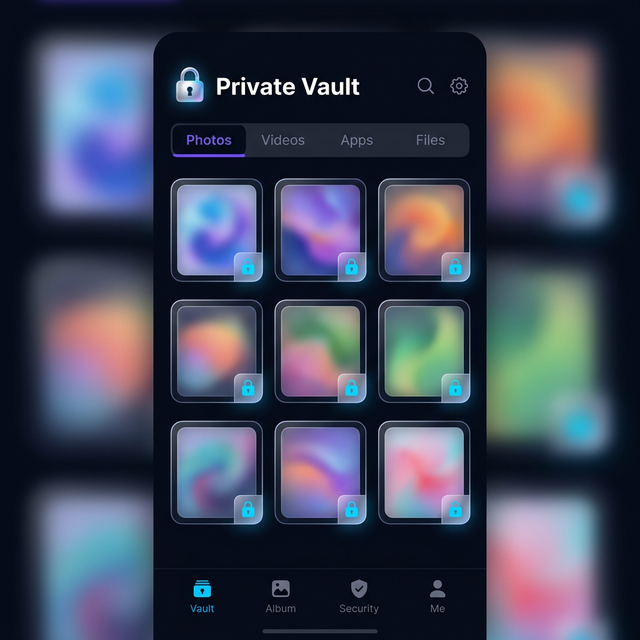
A vault app for sensitive files. For private photos, videos, documents, and notes, an encrypted vault is the most secure option. Files stored in the vault are inaccessible without the PIN, even if someone has physical access to the device.
A private browser. Browsing activity is one of the most revealing forms of digital data. Using a private browser for sensitive searches — medical research, financial planning, support resources — means that history is not visible to others who use the device or access your account. Our guide on how to use the private browser inside Calculator Hide App explains how this differs from ordinary incognito mode.
The point of these tools is not deception. They are the digital equivalent of having a private journal, a locked filing cabinet, or a private conversation with a friend. The relationship does not require you to give up all private space.
The disguise feature in Calculator Hide App — where the vault appears as a working calculator — addresses a specific anxiety that reasonable people have: not wanting the visible presence of a “privacy vault” app to prompt questions or accusations. A calculator on your phone is unremarkable. This is not dishonesty; it is the same logic that makes a locked diary less conspicuous than a safe.
Explore the full feature set of Calculator Hide App to understand what a modern privacy vault offers.
Having the Conversation About Privacy With Your Partner
If privacy in your relationship feels like a charged topic, the conversation is worth having explicitly rather than managing through technology alone.
Some couples benefit from explicitly agreeing on what each person considers private and why. This is not a negotiation in which your partner grants or denies you privacy rights — those rights are not theirs to grant. It is a conversation in which both people articulate their needs and build shared understanding.
The framing matters. “I need private digital space not because I am hiding things from you, but because privacy is how I maintain my individual self” is different from defensiveness or evasion.
If your partner’s response to “I want private space” is suspicion, hurt, or attempts to override that request, that is useful information about the relationship dynamic. Healthy partners can accept that you have private thoughts, private conversations, and private files.
Privacy as an Act of Self-Respect
The deepest argument for maintaining digital privacy in relationships is not about hiding anything specific. It is about the relationship you have with yourself.
Maintaining private space — a journal, a locked vault, a browser that does not sync — is an act of maintaining personhood. It is the recognition that you are an individual as well as a partner. That some things are yours to work through before sharing, some things are yours alone, and some things belong to relationships and commitments that precede or exist outside this one.
People who maintain healthy individual privacy tend to bring more to their relationships, not less. They are not depleted by the constant exposure of inner life. They have a self to bring to the partnership.
This is not an argument for isolation or for hiding. It is an argument for the kind of healthy individuation that makes sustainable intimacy possible.
If you want practical privacy tools that respect both your individual needs and the reality of shared digital life, read more about how to use Calculator Hide App safely and honestly.
Frequently Asked Questions
Is wanting digital privacy in a relationship a sign that something is wrong?
No. Wanting private digital space is normal and healthy. People have private thoughts, private professional obligations, private friendships, and private histories that do not belong to their relationship. The desire for privacy is not evidence of wrongdoing. Relationship health researchers consistently find that couples who maintain some individual privacy report better long-term satisfaction than those who attempt complete transparency.
Is it legal for my partner to read my private messages without my permission?
In most Western jurisdictions — the United States, UK, Canada, Australia, the EU — accessing another person’s private communications without their consent may violate computer access laws or wiretapping statutes. Being in a relationship does not grant your partner legal authority to access your accounts or read your private messages. The specifics vary by jurisdiction and context, but unauthorized digital access is a legal issue in most places.
What is the difference between healthy privacy and harmful secrecy?
Healthy privacy involves maintaining a personal sphere — thoughts, friendships, professional obligations, personal history — that is genuinely yours and not your partner’s business by default. Harmful secrecy involves actively concealing information that your partner has a legitimate interest in, particularly information that affects shared resources, health, or major life decisions. The distinction lies in whose business the information is, not simply in whether it is shared.
My partner checks my phone without asking. Is that normal?
Checking a partner’s phone without permission is not a relationship norm — it is a boundary violation. In controlling relationships, phone monitoring is a recognized tactic of coercive control. If your partner regularly accesses your device without your knowledge or consent, this is worth taking seriously as a relationship and potentially safety concern.
Can I use a vault app in a healthy relationship without it being deceptive?
Yes. Using a vault app for private files — work documents, medical records, personal photos, private notes — is not inherently deceptive. It is the digital equivalent of having a private journal, a filing cabinet with a lock, or a drawer you do not share. The presence of a private digital space does not mean you are hiding the relationship’s relevant information. Communicating openly about the fact that you maintain private digital space, without obligating yourself to share the contents, is the honest approach.
What should I do if I am in a relationship where my partner monitors my digital activity?
If your partner monitors your digital activity without your knowledge or consent — reading messages, checking location history, accessing accounts — this is a form of controlling behavior that domestic violence organizations recognize as intimate partner abuse. Reach out to a trusted friend, family member, or a domestic violence resource in your area. Privacy tools can help you communicate safely and access resources without that communication being visible.
Are there legitimate reasons a couple might share access to each other’s devices?
Yes. Some couples are comfortable with full device access and find it adds to their feeling of openness. Others share specific accounts — a shared calendar, a shared financial app — while maintaining individual privacy elsewhere. What matters is that sharing is consensual and mutual, not demanded unilaterally by one partner.
How do I talk to my partner about wanting more digital privacy?
Frame it around your needs rather than their behavior. “I want to maintain some private digital space — a personal journal, private conversations with my therapist, work communications — as part of how I take care of myself” is more productive than a defensive posture. A partner who responds to this with understanding is a healthier sign than a partner who responds with suspicion.
What categories of digital information are legally protected even in a marriage?
Medical records, therapy communications, private email and messages, browser history, and professional communications generally retain their private character within a marriage in most jurisdictions. Marriage changes some financial disclosure obligations in some contexts, but it does not create a legal right of access to a spouse’s medical records, private messages, or individual accounts.
Is using a calculator-disguised vault app in a relationship dishonest?
Using a disguised vault app is not inherently dishonest any more than using a locked diary is dishonest. The app protects the contents of private files — it does not create a secret relationship or conceal information your partner has a right to. If you are concerned about the dynamic, you can tell your partner that you use a vault app for private files without telling them everything in it. That is the difference between maintaining privacy and active deception.
Your privacy is yours — not contingent on permission, not evidence of wrongdoing. If you want a practical, secure tool for maintaining your private digital space, download Calculator Hide App and configure the vault that is right for you.